

SEND
SEND
(Special Educational Needs & Disability)

Useful links
At Heygarth Primary School we strive to support all children to enable them to achieve at school. We have high expectations for all and see each child as a ‘unique’ individual, supporting each pupil to reach their full potential, whatever their ability or specific needs. We ensure equality of opportunity for all within our school, with different steps taken to support children through their learning journey.
Should you have any questions about SEND, please speak to our SENDCo They can be contacted in person via the school office, by email to sendco@heygarth.wirral.sch.uk or by telephoning the school office on 0151 327 1570.
If a parent has a concern or complaint regarding Special Needs, they are encouraged in the first instance to meet with the class teacher and/or SENDCo. If this matter is not resolved satisfactorily the Headteacher should be notified.
If the concern is not resolved, parents have the right to ask for an examination of the complaint by the Governing Board.
See the school's Complaints Policy (in the 'Policies' section) for more information.
Please see full information in our SEND Policy & SEND Information Report below.
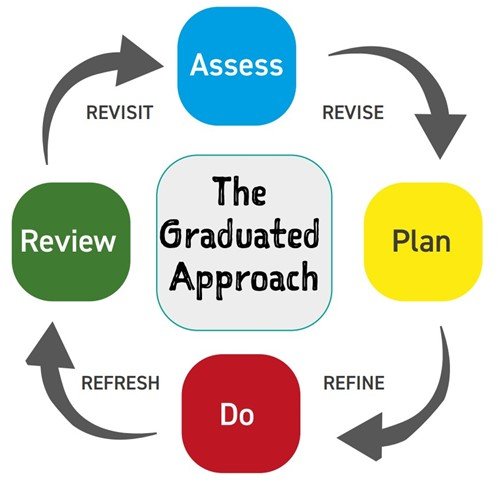
The Graduated Approach
The Graduated Approach is a four-part, continuous cycle used in mainstream schools and early years settings in England to identify, assess, and support children and young people with Special Educational Needs and Disabilities (SEND), set out in the SEND Code of Practice.
The 4-Part Cycle: Assess, Plan, Do, Review
Assess: Teachers, the Special Educational Needs & Disabilities Coordinator (SENDCo), parents, and sometimes external specialists analyse the child's needs using observations, formative assessments, and progress data.
Plan: The school and parents agree on expected outcomes, targeted interventions, and support strategies. These details are formally recorded in a support plan.
Do: Teachers, teaching assistants, or specialists implement the agreed-upon interventions and classroom adjustments.
Review: The impact of the support is evaluated at scheduled meetings (typically three times a year) with parents and staff to see what is working and whether targets need to be refined.